Make a donation to the Museum
Details -
License
Description
For all those lost to September 11, 2001 — on that day and in the years since — twenty-five years on, still mourned.
I was in my studio in Paris on the afternoon of September 11, 2001, drinking tea, when the phone rang. It was a friend who worked at the American Embassy. "Hiroshi, turn on the television," he said. "There's been a massive terrorist attack in New York. Don't go outside today." I remember fumbling for the remote, and then the image that filled the screen — a sight I had never witnessed before, and have not stopped thinking about since.
Twenty-five years later, I am still trying to understand what I saw that afternoon, an ocean away from where it happened. That distance is, I think, part of the story. I was not in New York. I did not lose anyone I knew. What I experienced was the event as an image — mediated, framed, already historical the moment it reached my screen. And it was from that position, as a witness at one remove, that I began to make the work that eventually became "MAD DOG TRAINING MADE EASY."
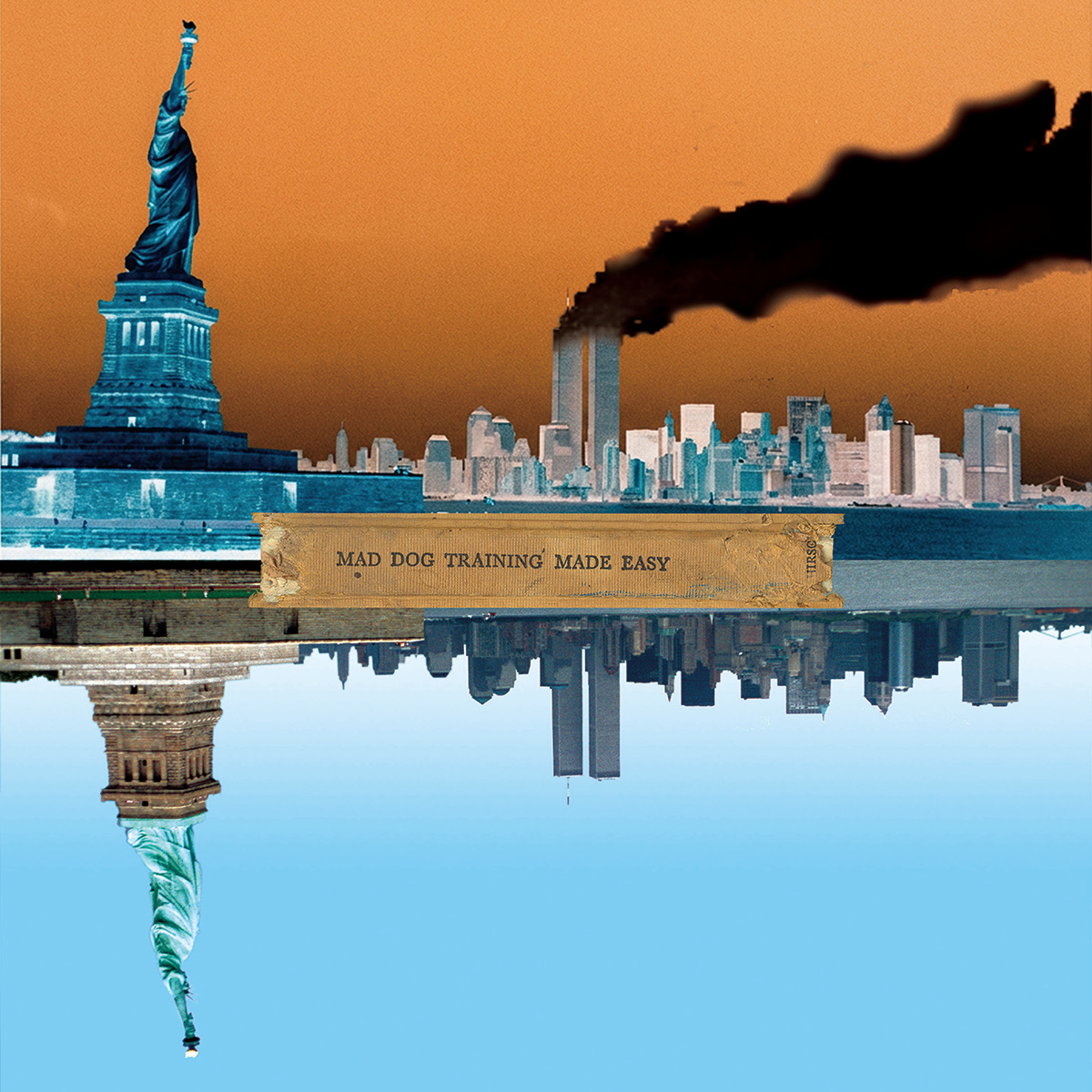
I have been an artist working across sculpture and, more recently, augmented reality, but this piece began, and remains, a photomontage — two skylines of New York fused into a single frame. The upper half is a negative: the Statue of Liberty and the World Trade Center standing beneath a column of black smoke, the space as it existed on that specific date, transfigured by the event. Mirrored below it, in blue, is a positive: the same skyline as it once existed, peaceful, before it was lost. I have spent much of my career preoccupied with the gap between a space that exists and a space that once existed — what a place carries after its physical form has changed or vanished entirely. September 11 gave that preoccupation its most brutal example.
The title is not a reference to American foreign policy, nor to the "War on Terror" that followed. It is a critique of something narrower and, I think, more disturbing: the machinery by which a human being is turned into an instrument of mass killing. Calling someone a "mad dog" is old rhetorical shorthand for an enemy beyond reason — but the phrase also describes, uncomfortably well, what indoctrination does to a person: it trains, methodically and with apparent ease, the capacity for atrocity. That transformation — the making of the weapon out of the person — is what the title interrogates.
I did not make this work in the days after the attacks. I made it a year later, once the initial shock had receded enough that I could look at the image without flinching, and could ask what, exactly, I wanted to preserve of that afternoon. That is, I think, one of the quieter functions art performs that news coverage cannot: a news image is built to be consumed once and replaced by the next one. An artwork is built to be returned to. I wanted an image that a viewer could sit with — in 2002, and now, twenty-five years later, on the day itself.
I am aware that posting a photomontage of the towers, on the anniversary, from an artist based in Tokyo who was in Paris that day, invites a fair question: what claim do I have to this image? I do not think distance disqualifies a response to atrocity — grief and alarm were not confined to Manhattan that week — but it does, I think, obligate a certain humility. I offer this work as a dedication, not a diagnosis. It belongs to everyone who lost someone that day, first, and to the rest of us, who lost something harder to name, second.
Twenty-five years on, I find I no longer know how to end this piece with confidence. I once believed the mirrored, peaceful half of the image — the "positive" beneath the "negative" — represented something recoverable, a world order that had merely been inverted and could, in time, be set right again. I am less sure of that now. So I will end instead with the question the work itself asks, unresolved, of anyone willing to sit with it a while longer: will the day ever come when that submerged, peaceful order returns to our hands?
“MAD DOG TRAINING MADE EASY” 2002, Digital photomontage, Lambda print
© 2002–2026 Hiroshi Chitose. All rights reserved.
Photo courtesy of AFLO; U.S. National Park Service.
Material
Digital photomontage, Lambda print, acrylic face mounting
Dimensions
900 x 900 mm